
Gibson County Release Date Types
Three dates answer different questions. Sentence expiration is the end of the imposed term after lawful computation. Release eligibility is the earliest point at which a person may qualify for a mechanism such as parole. Actual release is the physical custody event recorded by the releasing agency. A hearing date is only a scheduled proceeding, and a parole grant may still await a release plan, conditions, detainer work, and final processing.
The label on the individual record controls. TDOC does not promise that every public FOIL detail uses the words “Projected Release Date.” One record may show eligibility, expiration, release information, or a different sentence field. Capture the date with its exact label and the date it was viewed. Never convert one field into another.
| Date | What it establishes | What it does not establish |
|---|---|---|
| Release eligibility | A point when a release process may become available under the sentence | A guaranteed release or Board grant |
| Sentence expiration | The computed end of the imposed sentence | The same date as release from physical custody in every case |
| Actual release | The recorded departure from the named custodian | Full discharge or freedom from another detainer |
| Hearing date | A planned Board event | The outcome or door-out date |
Gibson County's Dual Population
The Gibson County Correctional Complex operates as the county jail and workhouse, but official records also show that it has held TDOC backup prisoners. Two people in the same Trenton building can therefore have different sentence authorities and different release-date channels. A local pretrial or misdemeanor record belongs mainly to the sheriff and court. A TDOC felony sentence remains a state computation even while the person is physically housed at the county complex.
Start with legal status, not the building name alone. For a local booking, request the booking record, court order, jail-credit information, and any sentence calculation held by Gibson County. For a TDOC prisoner housed there, search FOIL and select the county-jail route in TDOC Sentence Information. A move from Trenton to a state prison is a transfer and continued custody, not actual release.
The 2024 Tennessee Comptroller report documents the mixed local and TDOC population. It also provides historical context in which TOMIS location data did not always reflect physical location at Orchard House. Officials said identified issues were corrected or were to be corrected. That history makes a three-way check of legal custody, physical location, and release especially important in Gibson County.
Find Gibson County Release Dates
For a state offender, use the live TDOC FOIL search. Enter the last and first name, race, and optional aliases, or use the TDOC/TOMIS number or State ID. Complete the CAPTCHA. Compare identifiers, date of birth, offense, county, and location carefully when several records share a name.
FOIL may show status, location, offense, sentence information, parole-hearing status, and release information. Incarcerated means the person remains in state custody even if no Gibson jail screen shows the name. Parole or probation usually indicates community supervision, while inactive is a lead that still needs a precise release or discharge record. FOIL is not the right archive for a county-only bond-out, dismissed charge, or local misdemeanor that never reached TDOC.
- Decide whether the sentence is local, TDOC, federal, or tied to another custodian.
- For TDOC, search FOIL and match the correct person before reading any date.
- Write down the exact date label, status, location, and date viewed.
- For local custody, contact the Correctional Complex and the court of origin.
- Use TDOC Sentence Information when a state calculation is absent or unclear.
- Confirm the actual departure with the agency that released or transferred the person.
A broader named-person trail is available through the Gibson County release record search, which separates local, state, federal, and immigration systems.
The official FOIL form shows the fields used to begin the state lookup.
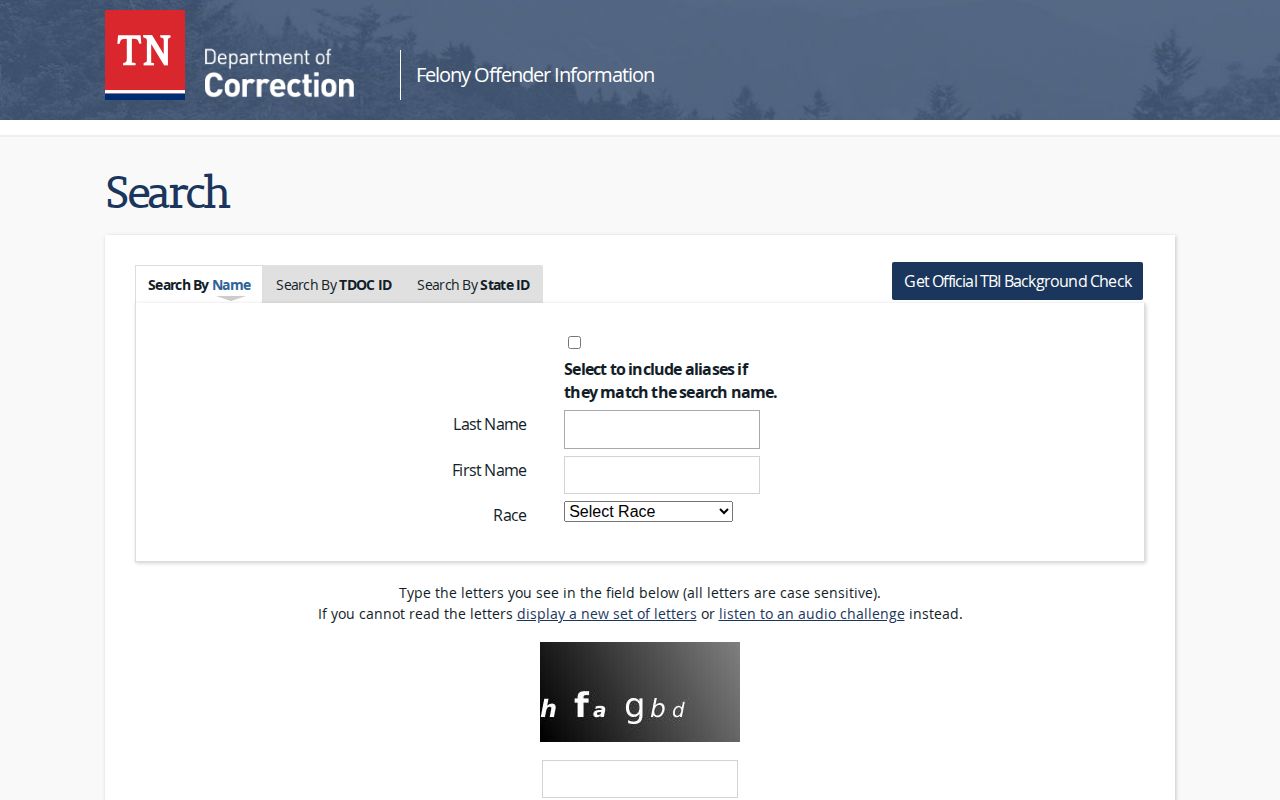
That form is useful only for a person with a TDOC custody or supervision history, not every person booked in Gibson County.
Gibson County Pretrial Release Dates
A pretrial detainee does not have a sentence-based projected release date. Release may follow posted and accepted bond, dismissal, a judge's order, or another lawful action, but pending cases and detainers can keep the person confined. “Bond set” is not the same as “bond posted,” and a dismissal in one case does not end holds in another case.
Ask the Gibson County Correctional Complex whether the person physically departed, the actual date and time, and whether the event was bond, court order, dismissal-related release, or transfer. Then obtain the signed court order from the originating clerk. A roster disappearance alone cannot identify the event because it may also reflect a transfer, spelling issue, or system refresh.
- Pretrial detainee
- A person held before final case disposition and without a sentence expiration to compute.
- Jail credit
- Time credited toward a sentence for qualifying time already spent in custody.
- Concurrent terms
- Sentences served at the same time, as the judgments direct.
- Consecutive terms
- Sentences served one after another, which can extend the computed end.
Gibson County TDOC Credits
T.C.A. § 41-21-236 authorizes TDOC sentence-reduction credits. The cited current version allows up to 16 days per month in qualifying circumstances, divided between institutional conduct and program performance, with additional education or treatment provisions and statutory exclusions. Credits can be reviewed, lost, or restored. For offenses and sentences after July 1, 2024, the statute also distinguishes credits that affect parole eligibility from the expiration date.
This does not justify a hand calculation. The person's offense, offense date, sentence structure, eligibility exclusions, conduct, programs, and later orders all matter. TDOC's computation is the authoritative state record. If the public detail does not explain the date, request sentence information rather than subtracting a general credit rate from the imposed term.
Note: Credits may change an eligibility or expiration calculation without proving the date of actual physical release.
Gibson County Eligibility Percentages
T.C.A. § 40-35-501 is offense-, date-, sentence-, and range-specific. It contains ordinary range rules, special categories, 85 percent provisions, and offenses that require 100 percent. Therefore, saying all Tennessee inmates serve 85 percent is wrong.
The cited text treats specified firearm offenses committed from July 1, 2021 through June 30, 2024 differently from those committed on or after July 1, 2024. For the first group, eligibility may begin at 85 percent less retained credits, but credits cannot reduce service below 70 percent. For the later group, eligibility starts at an undiminished 85 percent, while qualifying credits may reduce time before parole by up to 15 percent without changing expiration. Other offenses follow other rules or exclusions.
Parole eligibility also requires Board action. A grant can still await plan approval, conditions, or detainer resolution, and it can be rescinded before release. Use the person's exact judgment and TDOC calculation. Do not apply one offense category to another.
Gibson County Jail Computation
Local jail and workhouse calculations follow a different channel. T.C.A. § 41-2-147 and portions of § 41-21-236 can affect eligible county prisoners, while T.C.A. § 40-35-302 requires the court to fix a service percentage for misdemeanor confinement and limits how credits affect it. Pretrial jail credit, concurrent or consecutive judgments, later revocation, discipline, and amended court orders may all matter.
Request the judgment, court-set service percentage, jail-credit entry, and current calculation from the proper custodian. The sheriff can confirm the local record, while the court explains the judgment it entered. For a TDOC felony offender physically housed in Gibson County, use the County Jail option under TDOC Sentence Information. That routing is a direct result of the complex's dual population.
Gibson County Correctional Complex
401 N. College Street
Trenton, TN 38382
Phone: 731-855-1121
Posted office hours: Monday-Friday, 8:00 a.m.-4:30 p.m.
The posted office hours are not release-processing hours. No official Gibson release exit, time-of-day, weekend, holiday, or property-return procedure was located. Call before traveling.
Changes to Gibson County Dates
A public date can move because the inputs or legal status change. Do not announce an error merely because an earlier projection has passed. First determine whether the field was eligibility, expiration, a hearing date, or a true projection. Then ask the computing office to explain the current record.
| Factor | Possible effect | Best verification |
|---|---|---|
| Credit gain, loss, or restoration | Changes a lawful computation where the statute permits | TDOC or jail calculation |
| New or amended judgment | Adds, removes, or restructures sentence time | Signed court order |
| Concurrent or consecutive terms | Changes how multiple terms combine | Judgments and computation sheet |
| Detainer or hold | May cause transfer instead of community release | Releasing and receiving agencies |
| Parole decision | May allow supervised release, deny it, or set further action | Board final action and release record |
| Revocation or discipline | Can alter status or lawful credits | Final agency or court record |
No authoritative Tennessee or Gibson County rule was found that requires a Friday release whenever an expiration date falls on a weekend or holiday. Ask the jail or TDOC how the specific date will be processed. Do not turn a common practice from elsewhere into a Gibson County rule.
Confirm Gibson County Actual Release
For a local sentence, the Gibson sheriff record should state the actual date, time, release type, and destination category, subject to lawful limits. The court file supplies the judgment, sentence, credits, and release-related orders. For a state sentence, reconcile FOIL with TDOC Sentence Information or archived records. Ask for the calculation, release authorization, release date and type, or discharge certificate needed for the question.
If a public date has passed while the person still appears incarcerated, record the date label and when it was viewed before contacting the sentence office. New sentences, consecutive terms, lost or restored credits, detainers, amended judgments, recalculation, and Board action can alter the practical result. The agency's current computation should resolve the conflict.
A pending custody alert can supplement the record. The Gibson County VINE inmate check explains how to register on one person's record and how to verify an alert. VINE notice is not final proof, especially when a detainer causes a handoff. Always ask whether the person entered the community or another agency's control.
Note: Released describes leaving physical custody; discharged usually means custody and supervision under the sentence have ended.