
Gibson County Release Records Explained
A release from the Gibson County Correctional Complex has two parts. The first is physical departure from that building. The second is the legal status that follows. A person may walk into the community after bond, a dismissal, time served, sentence expiration, probation, parole, or another court-approved event. Someone else may leave the same building in a transport van bound for the Tennessee Department of Correction, another jail, federal custody, or an immigration custodian. That second person remains confined. A correct Gibson County release record must separate community release from transfer.
The Gibson County Sheriff’s Department operates the complex as both a county jail and workhouse. It has also held TDOC backup prisoners. That mix makes the agency trail more important than the door used to leave. Local booking and release documents are the key source for a county detainee. FOIL and TDOC sentence records control the state-prison history of a TDOC prisoner housed locally. A court order can explain why release was allowed, while the jail log records when the person actually departed.
A released person will often vanish from a live-custody display. That screen is meant to show who remains, not preserve a release history. Gibson County does not publish a verified official recent-release archive, so the underlying sheriff and court records are the durable local sources.
Ways Gibson County Inmates Leave
The words used for a custody change matter. Bond means a person leaves pretrial confinement but still has court duties. A bond amount on a docket does not show that it was posted or accepted. Time served and sentence expiration depend on the judgment, credit for prior confinement, and any lawful sentence credits. A dismissed charge can support release, but another case or hold may keep the person confined. Probation may replace confinement or follow split confinement. Parole is conditional release before sentence expiration under state supervision.
| Event | What it means | Best next record |
|---|---|---|
| Bond or court release | The person leaves local pretrial custody but the case continues. | Gibson jail release entry and court bond order |
| Time served or expiration | The local term ends after the lawful calculation. | Judgment, jail credit, and actual release entry |
| Probation or split confinement | The person serves a community sentence or the community part of a split term. | Court order and TDOC supervision status where applicable |
| Parole | A state prisoner enters the community under conditions before sentence expiration. | Board action, FOIL status, and TDOC release record |
| Transfer or detainer | One custodian hands the person to another. This is not freedom. | Sending agency record plus receiving agency confirmation |
| Dismissal | A charge ends, but another charge, case, or hold can remain. | Signed court disposition and jail departure record |
- Discharge
- The end of custody or supervision under the sentence, as stated by the responsible agency.
- Detainer
- A request or legal basis for another agency to take custody.
- Time served
- A sentence satisfied by time already spent in custody, subject to the judgment and lawful credits.
- Expungement
- A court-ordered process that can delete eligible charge records from official systems.
The source agency’s exact term should be preserved. “Released” can describe departure from one custodian, while “discharged” more often marks the end of the sentence or supervision.
Gibson County Release Record Fields
A focused request should seek facts that answer identity, authority, time, and destination. The booking number ties the release to one jail stay. The court and docket identify the case that may have caused confinement. The release authorization shows who ordered the change. Actual date and time are stronger proof of door-out than an estimated date or a court entry alone. Destination is vital because a transfer to TDOC, another county, BOP, or ICE is continued custody.
| Field | What it shows |
|---|---|
| Committed identity and identifiers | The person associated with the booking, checked against known details |
| Booking number and date | The exact Gibson County custody episode |
| Arresting agency, charge, court, docket | The source case and agency trail |
| Bond amount and status | Terms and whether the record shows posting, not merely an amount |
| Release authorization | The order or lawful basis for the custody change |
| Actual release date and time | When physical custody at the complex ended |
| Release type and destination | Whether the person entered the community or another custodian took control |
A booking photograph may be held as a separate record. TDOC Policy 511.03 uses a state release-notice model with the offender name, TDOC ID, conviction date and county, date of birth, offense, release type and date, sentence expiration, and intended city and state. FOIL may show only some fields. Ask for the source record when a missing field affects the conclusion.
Note: Online visibility and legal retention are different; Gibson County publishes no fixed online retention period for former detainees.
Request Gibson County Release Records
The official Gibson County Sheriff’s Department page identifies the Correctional Complex as the local contact. No verified sheriff-specific online request form, email address, or local fee schedule was found in the research sweep. Call first and ask for the current public-records custodian, accepted form, delivery address, citizenship proof, and adopted fee policy. Ask for existing records rather than asking staff to create a new report.
- Identify the person with a full name, known date of birth where appropriate, booking date range, and booking or case number if available.
- Request the booking sheet, custody-status history, release authorization, actual release date and time, release type, destination agency category, and booking photograph as separate existing items.
- State whether inspection or copies are sought and the desired format. Ask for a cost estimate before paid copies are made.
- Ask the custodian to identify the legal basis for each redaction or withheld record and to release any reasonably separable public material.
- Reconcile the jail response with the final court order or TDOC record when the person had a state sentence.
The Tennessee Public Records Act guidance says inspection is generally free for Tennessee citizens. Copies may require a written request and proof of citizenship. The Office of Open Records Counsel default schedule lists 15 cents for a black-and-white letter or legal page and 50 cents for color, plus permitted labor in some cases, but the custodian’s adopted policy controls. When records cannot be produced promptly, T.C.A. § 10-7-503(a)(2)(B) generally calls for production, a written denial, or an estimate of additional reasonable time within seven business days. It does not promise completion by then.
Gibson Release Orders Start in Court
Gibson County cases require court-of-origin routing. Tennessee has no statewide trial-court name search equivalent to FOIL. The Public Case History covers appellate courts only, so it cannot replace a General Sessions or Circuit Court file. Use the official Gibson clerk directory to locate the correct office. Circuit Court Clerk Cindy Flowers’s listed Trenton office can route a request when the courthouse or venue is not clear.
Ask for the register or docket and the signed document that resolved custody. Depending on the case, that may be a bond order, proof of posting, dismissal or nolle prosequi order, judgment, sentence, jail-credit entry, probation or split-confinement order, revocation order, or discharge. A docket note may summarize an event. The signed order is stronger evidence of judicial action, but only the Gibson jail record confirms the time of physical departure.
Does a dismissed charge prove release? No. Another count, case, probation hold, or detainer may still support custody. Check all linked cases and the jail’s final disposition.
Note: Gibson County has used more than one court venue, so ask which clerk location holds the criminal file.
Why Gibson Release Records Disappear
Tennessee expungement can change an official search result. The Tennessee Courts expungement information explains that an order is sent to the arresting agency, county jail, TDOC, and TBI. TBI deletes covered charges rather than adding a simple sealed label. A later no-result may therefore reflect lawful deletion. It does not prove that no booking ever occurred.
Eligibility depends on the case and T.C.A. § 40-32-101. Dismissed, nolle prosequi, no-true-bill, and not-guilty matters may qualify without cost, while conviction expungement has offense-specific limits and waiting rules. No single waiting period applies to every conviction. Sealed records and juvenile material may also be unavailable under separate rules. Do not use another database to bypass a court restriction.
The current court order controls. A stale private copy may fail to reflect the legal change, while the official agency has already removed the covered item. Request correction from the source that displays the conflict and provide the order through its secure process.
Find Gibson County Released Inmates
Start with the kind of custody, not with one broad name search. A local arrest that never became a TDOC case belongs in the sheriff and trial-court files. A felony offender held by or supervised through TDOC belongs in FOIL and TDOC records. VINE is useful for current events and alerts. Federal and immigration matters use their own systems. This split prevents an old state record from being mistaken for proof of a newer Gibson County release.
- Confirm the source is Gibson County, Tennessee. The official county root is gibsontn.org, and the jail is in Trenton with a 731 telephone code.
- Call the Correctional Complex. Ask whether the person physically left, the actual date and time, release type, and receiving agency if staff says transferred.
- Check FOIL if state custody or supervision may apply. Read the exact status and any release or sentence fields shown.
- Search Tennessee VINE for a current agency event and register for future changes, while confirming Gibson feed participation.
- Obtain the court disposition. The court proves the legal order; the jail or TDOC proves the actual custody event.
- Use BOP or ICE only when federal or immigration custody is supported, then request records when the public screen is not enough.
The focused Gibson County Correctional Complex release page covers local contact and facility-specific routing. When a record conflicts with what a family member observed, preserve the agency wording and date, then ask the agency that created the record to resolve it.
Note: Keep each agency event in date order so an older inactive TDOC record is not tied to a newer jail stay.
FOIL Search for Gibson Releases
The TDOC FOIL overview says the system covers people currently or formerly in TDOC custody or supervision. It may show a photo, status, location, offense, sentence information, parole-hearing status, and release information. Availability differs by record. The live FOIL offender search accepts name-based or identifier-based queries.
| Search field | Use and limits |
|---|---|
| Last and first name | Use the committed name and compare more than spelling alone. |
| Race and aliases | Narrow similar names or account for a known alternate name. |
| TDOC or TOMIS ID | Direct state record identifier when known. |
| State ID or SID | Alternative identifier available on the form. |
| CAPTCHA | Required to submit the live public search. |
Read status with care. Incarcerated means state custody, even if the person left the Gibson jail. Parole or probation usually points to community supervision, though a violation or detainer can complicate location. Inactive means TDOC is not actively incarcerating or supervising the person, but it is not a release type or date. Use release details, TDOC Sentence Information, or archived records to resolve missing facts. County-only bond-outs, dismissed charges, and misdemeanor stays may never appear in FOIL.
The official TDOC FOIL search source shown below makes the name and state-identifier routes visible.
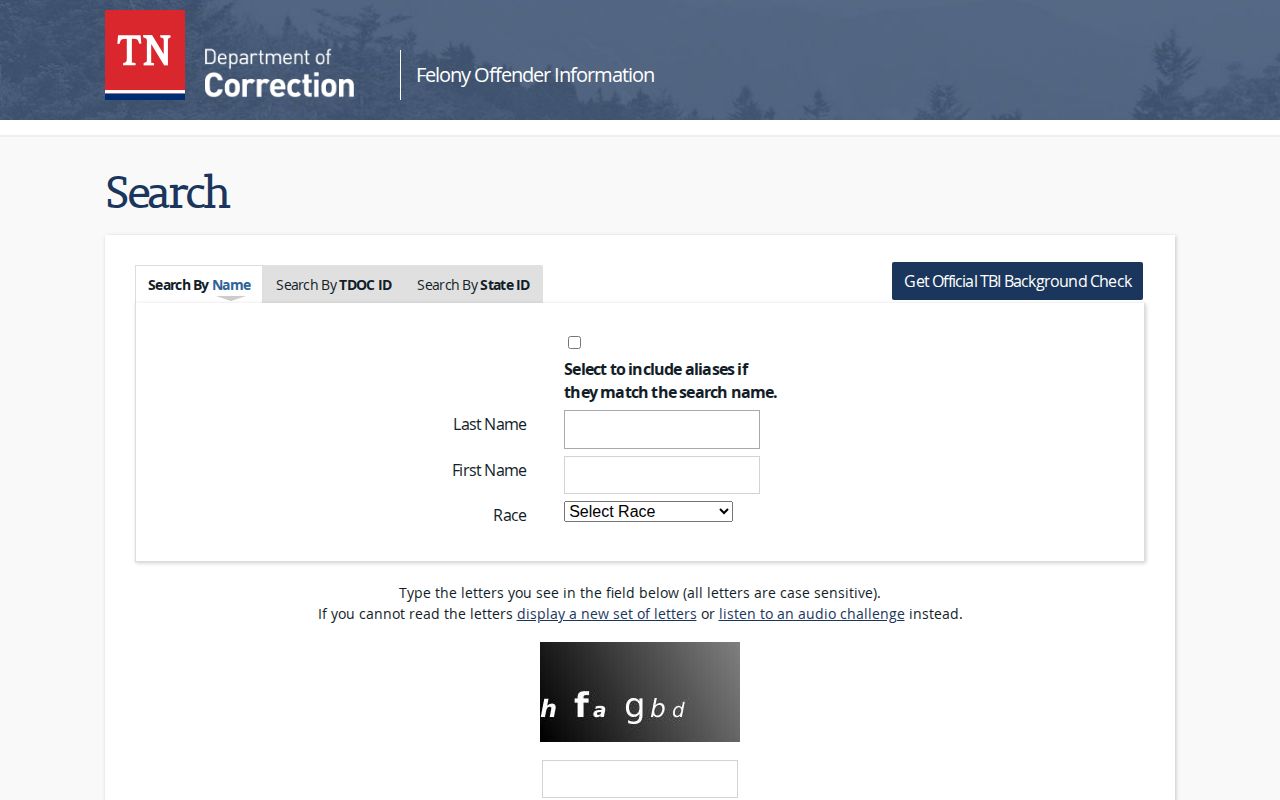
The screen is a statewide state-corrections tool, so its results must be kept separate from county-only Gibson booking records.
Gibson Release Records Need Cross-Checks
The Gibson County Correctional Complex has a local jail role and a workhouse role, and it has held prisoners already sentenced to TDOC custody. A 2024 Tennessee Comptroller investigative report also documented historical cases in which TOMIS location data did not match a person’s actual noncustodial location at Orchard House. The report says county officials corrected or intended to correct identified deficiencies. Allegations described in the report are not convictions.
That history does not make each current Gibson record unreliable. It shows why physical location, legal custody, and community release are separate facts. For a local person, compare the jail timestamp with the court order. For a TDOC backup prisoner, compare FOIL and sentence data with the facility event. If the jail says transfer, obtain the receiving agency. A move from Trenton to a state prison remains confinement even though the person has left Gibson County.
Note: Two people can leave the same Gibson building while producing different county and state record trails.
When Does Gibson Release Inmates
The county posts office contact hours of Monday through Friday, 8:00 a.m. to 4:30 p.m. It does not publish release-processing hours. No official source found in the research sweep states a release exit, weekend or holiday rule, property-return process, family waiting point, transit stop, rideshare policy, or jail-provided ride. Office hours must not be treated as a promise about door-out time.
Call 731-855-1121 before traveling to Trenton. Ask whether release has been authorized, whether another hold remains, and whether staff can share a safe current pickup instruction. Court schedules, transport, record checks, detainers, and agency processing can affect timing. A projected date or parole grant is not the same as a completed release.
A family member should not rely on an unverified web listing. The official Gibson County government root is the stable fallback if a sheriff deep link moves during a site migration.
Gibson Release Alerts and Supervision
Tennessee SAVIN operates through VINELink. Search Tennessee by an exact name or offender ID, open the matching agency record, read the status and event date, and register for channels offered on the live screen. Alerts may be available by telephone, text, email, TTY, or app. The state describes VINE as free and confidential, but its cited page says many county jails participate rather than guaranteeing every Gibson booking feed. Call Tennessee VINE at 888-868-4631 or the jail to confirm current participation.
VINE is an event alert, not a certified historic release ledger. A missing name may reflect spelling, an older event, feed lag, transfer, or nonparticipation. Save the exact agency, event wording, and date from any alert, then ask that agency for the release type and destination.
FOIL can show parole or probation for a person under TDOC Community Supervision. The Tennessee Board of Parole makes parole decisions, while TDOC field staff supervise parole and probation. District 61 in Dresden serves Gibson County. Parole is conditional community release, not full sentence discharge. More detail belongs in the Post-Release Supervision record path.
Note: No VINE alert does not prove continued custody; first confirm registration, the selected agency, and Gibson feed participation.
Gibson Releases and ICE Transfers
A detainer can make one agency’s “release” the start of another agency’s custody. TDOC Policy 511.03 directs notification users to SAVIN when a state prisoner leaves TDOC on a Tennessee county detainer. The same principle applies when a person leaves the Gibson complex for state, federal, another county, or immigration custody. Ask for the destination agency before describing the event as community release.
The ICE Online Detainee Locator accepts a nine-digit A-number and country of birth, or an exact name and country of birth. ICE says the tool covers current detainees and people released from ICE custody within the prior 60 days. The official ICE locator guidance confirms that limited recent-release window. A no-result can reflect a record older than the window, spelling, transfer, removal, data lag, or no ICE custody.
For a federal sentence, use the BOP Inmate Locator. It covers federal prisoners from 1982 forward and may show a release date with “Not in BOP custody” or no present facility. That proves only the end of BOP confinement. It does not rule out state, county, immigration custody, or federal supervision.
Compare Gibson Release Search Paths
Each official channel answers a narrow question. Search results become more reliable when they are placed in time order: Gibson booking, court order, transfer or actual release, later state or federal admission, and any supervision. Do not merge several agencies’ dates into one vague release date.
| Situation | Best source | What it can establish |
|---|---|---|
| Current Gibson custody | Correctional Complex | Whether the person remains there now |
| Past local jail stay | Sheriff release record and trial court | Actual departure, type, destination, and legal order |
| TDOC custody or supervision | FOIL and TDOC records | State status, sentence, release information, or supervision |
| Expected custody change | VINE plus source agency | Timely alert followed by official confirmation |
| Federal custody | BOP locator and federal court | BOP confinement and federal judicial record |
| Recent ICE event | ICE ODLS and ERO | Current or recent ICE custody within the published window |
Only one correctional facility was verified within Gibson County. The Gibson County Correctional Complex at 401 N. College Street in Trenton handles local jail and workhouse custody and has held TDOC backup prisoners. No separate state prison, federal prison, or verified ICE detention center was found within the county. A case can still move to those systems after leaving the complex.
Note: A source date matters because public portals, agency links, and the absence of a county release feed can change.