
Gibson County Supervision Types
Parole and probation both allow a person to live in the community under rules, but they begin through different legal acts. The Tennessee Board of Parole decides parole. Tennessee Department of Correction Community Supervision carries out field supervision for both parole and probation. A judge imposes probation, either as the whole community sentence or as the community part of a split sentence after some jail time.
The distinction affects which record proves the status. A Board decision can show that parole was granted, yet it does not prove the person walked out of custody. Release-plan approval, detainers, conditions, and institutional processing may still stand between a grant and physical release. A probation order establishes the court's terms, while TDOC FOIL can show an active probation status for a person in the state system.
| Issue | Parole | Probation |
|---|---|---|
| Who authorizes it | Tennessee Board of Parole | Sentencing court |
| When it begins | After custody and an approved release process | As ordered, including after split confinement |
| Who supervises | TDOC Community Supervision | TDOC Community Supervision for covered cases |
| Best proof | Board action, actual release record, and FOIL status | Court order and FOIL status |
| End point | Sentence expiration or formal discharge shown by the record | Completion or discharge under the court and supervision record |
- Parole
- Conditional release from confinement before the sentence expires.
- Probation
- A court-ordered community sentence, sometimes following a term of split confinement.
- Discharge
- The formal end of custody or supervision under the sentence.
- Detainer
- A request or order that another agency take custody.
Verify Gibson County Supervision
The official public starting point is TDOC Felony Offender Information Lookup, commonly called FOIL. It covers people currently or formerly in TDOC custody or supervision. Search by first and last name, with race and aliases when useful, or by a TDOC/TOMIS number or State ID. The result may label a person incarcerated, on parole, on probation, or inactive. Match identity with care before relying on a status.
FOIL is not a county booking archive. A local Gibson bond-out, dismissed charge, or county-only misdemeanor may never appear there. For that person, the Correctional Complex release record and the court order are the better sources. A status conflict calls for a direct agency check, not a guess based on a missing name.
- Search FOIL using the person's exact name or known state identifier.
- Open the matching record and compare identity, conviction county, offense, and location details.
- Read the precise status. Parole or probation indicates supervision, while inactive needs further explanation.
- Use the sentence and hearing information that appears on the individual record.
- Contact District 61 for reporting-jurisdiction questions or the Board for a parole decision record.
- Confirm physical release through the releasing agency when the date or destination matters.
For the wider custody-to-release trail, the Gibson County released-inmate lookup separates county, state, federal, and immigration routes.
Gibson County District 61 Office
Gibson County does not have its listed TDOC community-supervision office inside the county. The official TDOC Field Office Directory assigns Gibson to District 61 in Dresden. The office is shared with Carroll and Weakley for the listed address, and District 61 also serves several other West Tennessee counties. That regional structure is easy to miss when someone assumes the Trenton jail supervises people after release.
The office can route a current jurisdiction question, but it should not be asked for needless private reporting details. Use FOIL first. Then call only when the public status conflicts with another custody signal or when official routing is needed. The Gibson County Correctional Complex controls its own local custody and release records. It is not the parole or probation field office.
TDOC Community Supervision District 61
8593 Highway 22
P.O. Box 749
Dresden, TN 38225
Phone: 731-364-3147
Fax: 731-364-5646
The official District 61 listing shows the regional assignment. Its layout can be seen in the state directory capture below.
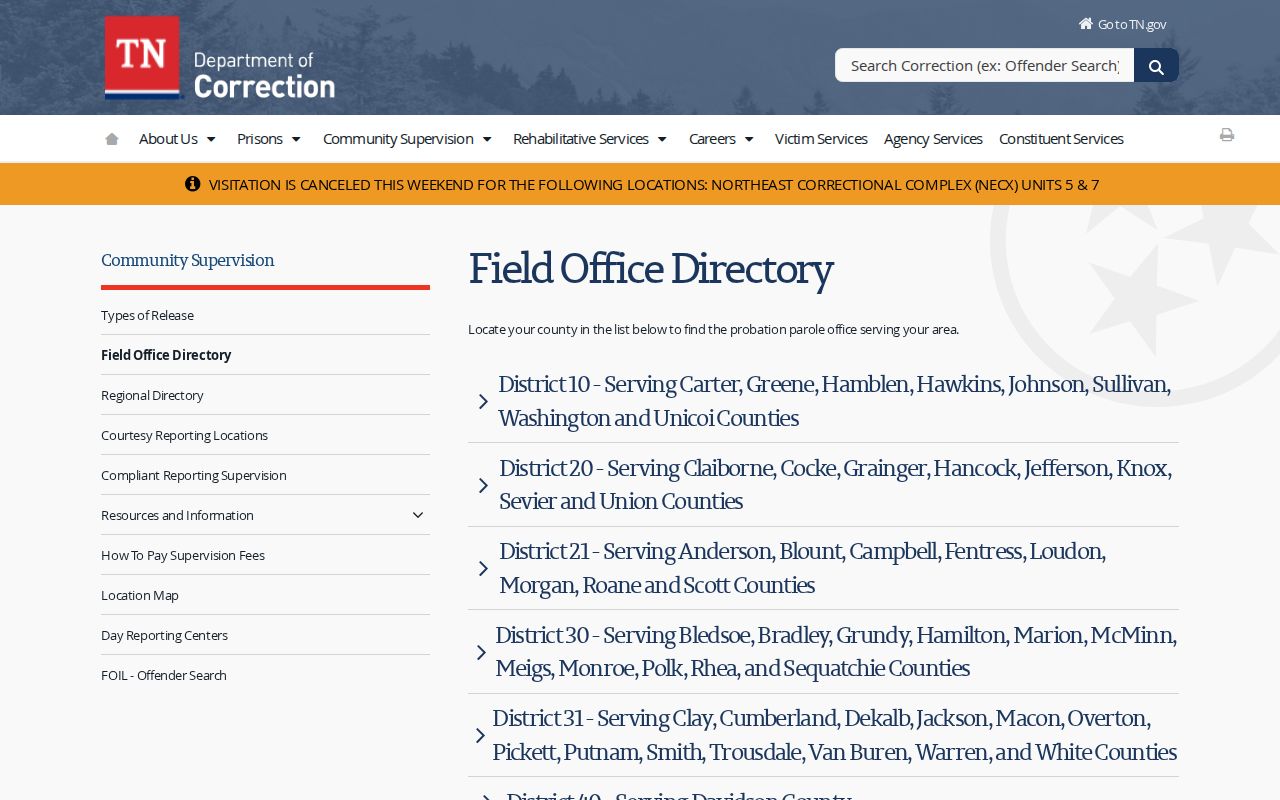
The directory confirms why a Gibson supervision check may lead from Trenton to Dresden even though the original jail record remains in Gibson County.
Gibson County Release Conditions
TDOC's Types of Release distinguishes parole, probation, determinate release, and mandatory reentry supervision. Each has its own source of authority. The page states that probationers must report within 48 hours of placement on probation or release from split confinement. That rule is a reporting duty, not a universal way to calculate when a person leaves the Gibson County Correctional Complex.
Some qualifying offenses committed on or after July 1, 2021 may involve one year of mandatory reentry supervision under T.C.A. § 40-35-506. Whether it applies, and where that period sits in relation to sentence expiration, depends on the person's statute and record. The official computation controls. Conditions may address reporting, travel, programs, contact, or other case-specific duties. A general list cannot replace the actual order.
Note: Community supervision means release from confinement under conditions; it does not mean the sentence has been fully discharged.
Gibson County Violation Status
An alleged violation, absconder entry, or warrant can affect supervision without proving where the person is. An absconder is someone alleged to have stopped reporting or otherwise lost contact with supervision. A warrant authorizes an arrest, but it does not establish that the arrest has occurred. No Gibson County TDOC absconder list was located in the official research sweep, so county news or a most-wanted post should not be relabeled as a supervision roster.
Check FOIL for the current state status, contact District 61 when a reporting-jurisdiction issue needs official routing, and check the correct warrant-holding agency or new jail booking when physical custody is the question. Tennessee VINE may give a custody-change alert for a participating agency. It is not a warrant database and cannot resolve a violation on its own.
Gibson County Parole Hearings
The Board's hearing schedules are updated weekly on Monday, or Tuesday after a Monday holiday. A copy can be requested at BD.HearingSchedules@tn.gov, and a changing date can be checked at 615-741-1150. Select county-jail hearings may allow virtual participation under the current Form 0280 process. The schedule is notice that a hearing is planned, not proof of its result.
The Board uses several hearing types. They include grant, preliminary and final revocation, custodial, pre-parole and post-parole rescission, time-setting, and appeal hearings. A final revocation may revoke or reinstate supervision. A rescission can undo a grant before release. Board members may adopt, change, or reject an officer recommendation, so the hearing label alone cannot establish the outcome.
No separate public Board decision-results search was found. FOIL may show hearing status. For the definitive result, request the final action or vote sheet from the Board. An eligible appeal request generally must arrive within 45 days after the person receives the final decision and must rest on significant new information, hearing-official misconduct, or significant procedural error under the Board appeal process.
Gibson County Grant Versus Release
Parole eligibility in Tennessee turns mainly on T.C.A. § 40-35-501, including the offense date, conviction, range or class, sentence length, exclusions, consecutive terms, and credits. The cited text generally limits parole consideration to felony terms over two years, or consecutive felony terms totaling more than two years, subject to statutory exceptions and processes. There is no safe universal percentage for Gibson County cases.
After a grant, the release plan still may need approval. Detainers must be resolved, conditions set, and the institution's release work completed. A pre-parole rescission can end the grant before the person leaves. Confirm the Board action, the releasing facility's actual release entry, and FOIL's later supervision status as separate facts.
Note: Ask for the destination agency when a detainer is present because a handoff remains custody even if one system calls it release.
Gibson County Supervision Discharge
Supervision ends when the controlling sentence and agency record show completion or formal discharge. An inactive FOIL status can be a useful lead, but it does not explain the legal basis or exact end date by itself. Open the detail for release or sentence information. If the needed field is missing, use TDOC Sentence Information or request the sentence computation, release authorization, supervision start and end record, or discharge certificate from TDOC Records Management.
For an archived TDOC request, identify the person by full name, TOMIS number, and date of birth when known, then describe the exact supervision or discharge document sought. TDOC may assess archive charges after the search and advises requesters of the amount. Sensitive identifiers should go only through the secure agency channel. They should never be sent through an ordinary public search form.
Keep three events distinct: leaving the Gibson County Correctional Complex, beginning community supervision, and ending supervision. They can occur years apart and belong to different custodians. The sheriff proves the local door-out event, the court proves its orders, the Board proves parole action, and TDOC proves state sentence and supervision history. Matching those records prevents a parole status from being mistaken for full discharge.